
TALLY ENTRIES 771-780
When I "retired" from systematic visual comet observing at the end of 2024 I did so with the caveat that I might occasionally "come out of retirement" for bright and/or interesting comets, and accordingly I expected to add additional comets to my tally from time to time. I never really thought, however, that I would completely fill up a ten-entry page and start a second such page in less than a year, but with the flurry of "bright and/or interesting" comets that appeared during the latter months of 2025, here I am . . .
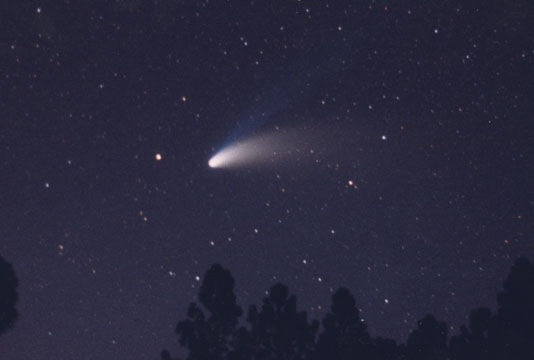
This particular comet is an intrinsically faint short-period object that I have seen on three previous returns, beginning with its discovery return in 2003 (no. 335) and then in early 2009 (no. 446) as a part of "Countdown" and more recently in 2020 (no. 677). In my write-ups for both the 2008-09 and 2020 returns I noted that the return this year would be a relatively favorable one, and in due course the comet was recovered on July 20, 2025 by the Pan-STARRS survey in Hawaii, about three weeks before it went through opposition. It remained primarily within southern hemisphere skies afterwards and was imaged on a fairly regular basis, and I successfully imaged it a couple of times (in mid-September and early October) via the Las Cumbres Observatory network when it was still a relatively faint object near 18th magnitude. It apparently began to brighten somewhat rapidly after that, and when the final images were obtained by observers in the southern hemisphere at the beginning of November before it entered evening twilight, it was near 12th to 13th magnitude.
Comet Christensen was nearest Earth (0.43 AU) on November 9 and went through inferior conjunction with the sun about a week later, and by the last few days of November began emerging into the northern hemisphere's morning sky. The earliest post-perihelion images I'm aware of were taken on the 26th, when its elongation was 26 degrees, and showed it as being between magnitudes 9 1/2 and 10. The comet's elongation has been steadily increasing since then, but in all honesty in my current state of "retirement" I wasn't sure I would bother looking for it. However, on the morning of December 2, when I was already up to obtain one final observation of Comet 3I/ATLAS (no. 769) -- now having faded slightly, to a bit below 10th magnitude -- before the full moon, I decided I would go ahead and try for it (with its elongation having by then increased to 34 degrees), and after it had emerged from behind the trees I have in that direction I successfully detected it near the beginning of twilight as a small and moderately condensed object near magnitude 10 1/2.
Comet Christensen is presently located in southeastern Virgo 2 1/2 degrees east of the star Kappa Virginis and is traveling towards the northeast at slightly over 20 arcminutes per day, gradually curving more directly eastward. As it continues pulling away from both the sun and Earth its elongation hereafter increases more slowly, to only 44 degrees by mid-December and to 54 degrees by the end of the year; meanwhile it will likely fade quite rapidly. With all this, and with the bright moon now in the morning sky, it is rather unlikely that I will look for it again. But, to address the thoughts that I expressed at the end of my write-up for its 2020 return, I was indeed able to grab at least one observation of this comet this time around . . . and, for whatever it's worth, this turns out to be the brightest observation I have ever made of it.
INITIAL OBSERVATION: 2025 December 2.52 UT, m1 = 10.4, 1.4' coma, DC = 4-5 (41 cm reflector, 70x)
772. COMET P/(139359) P/2001 ME1 Perihelion: 2001 August 12.36, q = 0.357 AU
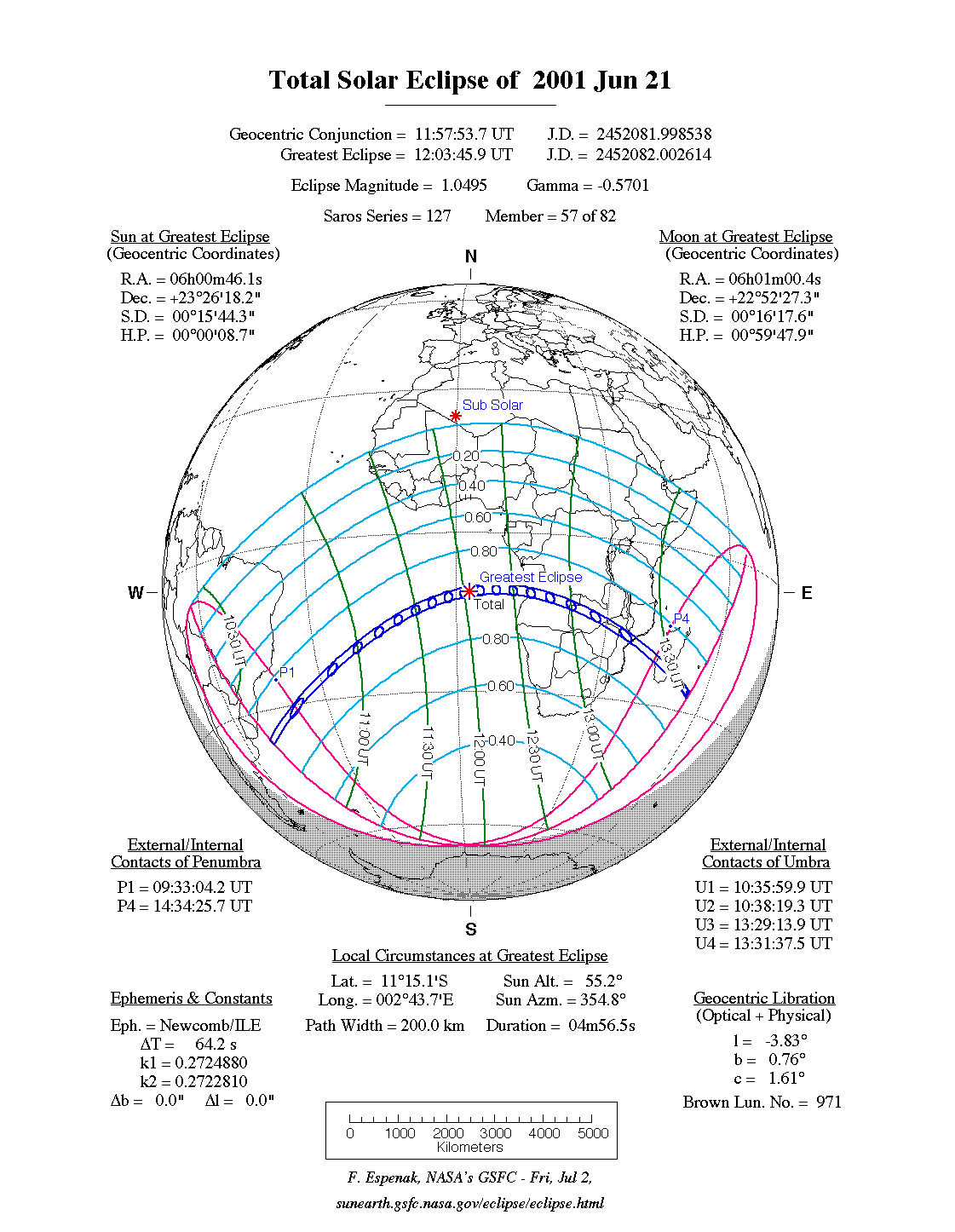
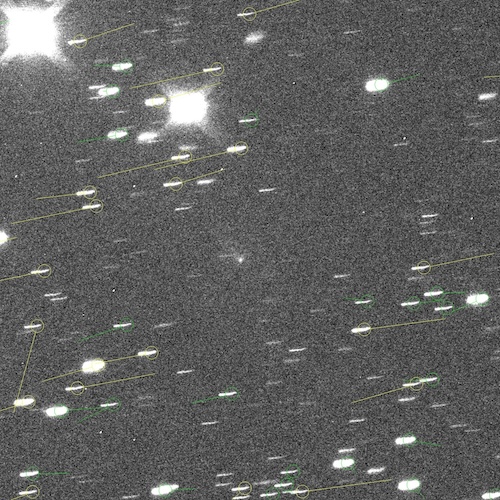
Once again, I add a comet to my tally retroactively, an object I briefly observed as an "asteroid" on a single night almost a quarter-century ago. It was discovered on June 16, 2001 by the LINEAR program in New Mexico, already a somewhat bright object near 14th magnitude. I happened to be in Zimbabwe at that time, in order to observe the total solar eclipse that took place on June 21, but after my return a few days later I tried to make plans to observe it. The evening of the 25th started out cloudy, but towards midnight I saw that the sky had cleared somewhat, and despite the fact that its altitude was starting to get somewhat low and the conditions still weren't ideal, I managed to spot 2001 ME1 as a stellar object near magnitude 14 1/2 (although given the conditions I considered this somewhat uncertain and suspected that it might have been slightly brighter than that). I was only able to follow it for about eight minutes before clouds moved in again, but during that time I detected clear motion (as it was then traveling at over seven degrees per day).
At the time of my observation 2001 ME1 was located 0.110 AU from Earth, and it passed 0.097 AU from Earth on the 29th (which, incidentally, puts it in 13th place on the list of closest-approaching comets on my tally). It rapidly moved inside Earth's orbit and accordingly faded quickly, and this, combined with its rapidly-shrinking elongation as well as increasing moonlight in the evening sky kept me from attempting to observe it again. The final ground-based observations before it disappeared into sunlight were obtained on July 4, and it was later picked up as a faint object in mid-January 2002. After observations were obtained around the time of its subsequent perihelion passage in December 2005 it was assigned the permanent number (139359) in December 2006.
(139359) 2001 ME1 travels in an orbit with a period of 4.3 years and an eccentricity of 0.87, which can be considered "cometary." The cometary nature of its orbit was evident at the time of its discovery announcement, and even in my observing notes for my observation I put the word "asteroid" in quotation marks, in anticipation of the possibility that it might actually be found to be a comet at some point. For the next couple of decades it was never observed as cometary, however just over a year ago it was identified as a member of a recently-christened class of objects called "dark comets," i.e., apparent "asteroids" that exhibit non-gravitational forces indicative of a cometary nature but not exhibiting cometary activity. In my statistical analysis that I completed after my "retirement" from systematic visual observing at the end of 2024 I specifically mentioned it in this context as a reasonable candidate for a retroactive addition to my tally someday.
In a just-published paper written by Qicheng Zhang at Lowell Observatory and his colleagues, the authors identified (139359) 2001 ME1 with a comet that was discovered by Thai researcher Worachate Boonplod in images taken by the LASCO C2 and C3 coronagraphs aboard SOHO shortly after mid-November 2018. The authors then were able to identify it in images taken with one of the Heliospheric Imager instruments aboard the STEREO-A spacecraft, and in ground-based images taken in early December 2018 by the Zwicky Transient Facility (ZTF) survey in California, where it initially appeared marginally cometary. They have also identified it in STEREO-A images taken in July and August 2014 and it also appeared marginally diffuse in ZTF images taken in March 2023. At the time of the LASCO and STEREO observations in 2018 it appeared at a very high phase angle (peaking at 176 degrees) which accordingly produced strong forward scattering of sunlight and a distinct cometary appearance. The identification as a comet seems solid, although the data indicate a very low activity level (a small fraction of 1% of the activity level of a more typical cometary nucleus of a similar size). The orbit has apparently been relatively stable for several millennia and the repeated close passages to the sun have apparently all but depleted its supply of volatile materials.
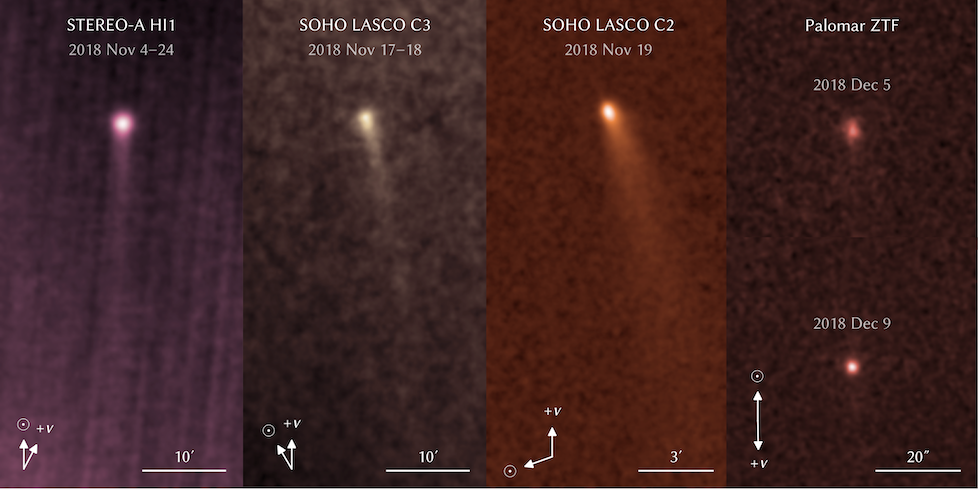 Figure 2 from the paper by Zhang et al (2026). These are "stacked" images taken by the LASCO coronagraphs aboard SOHO and by one of the Heliospheric Imagers aboard the STEREO-A spacecraft, as well as two ground-based images taken during the course of the Zwicky Transient Facility (ZTF) survey.
Unfortunately, it does not appear that this newly-identified comet will be amenable to detailed observations anytime within the near-term future. Its next perihelion passage is in June 2027, although this takes place on the far side of the sun from Earth, and thus there will not be any forward scattering enhancement when it passes through the LASCO field of view; it may be observable from the ground a couple of months earlier when it should be near 18th or 19th magnitude. It makes somewhat close approaches to Earth in September 2031 (0.63 AU) and in February 2036 (0.44 AU); the earlier of these does take place near inferior conjunction (and a corresponding phase angle of 170 degrees) and thus there should be some forward scattering enhancement detectable by whatever coronagraphs might be operating then. There are some very close approaches to Earth later in the 21st Century -- 0.117 AU in February 2062 and 0.070 AU in June 2070 -- but, of course, any observations then will have to be made by future generations of observers. Curiously, the comet also passes close to other planets in the inner solar system, for example, both Venus (0.047 AU in June 2053 and 0.083 AU in September 2057) and Mercury (0.034 AU in August 2057 and 0.039 AU in December 2061) have close approaches, and the comet passes only 0.015 AU from the large main-belt asteroid (4) Vesta in February 2032.
OBSERVATION: 2001 June 26.23 UT, m1 = 14.4:, 0.0' coma, DC = 9 (41 cm reflector, 189x)
773. COMET MAPS C/2026 A1 Perihelion: 2026 April 4.60, q = 0.006 AU
The first "real-time" addition to my comet tally in 2026 comes at a time of deep emotional turmoil for me. A week and a half ago the government of this country launched an unprovoked, illegal, and unconstitutional war against the nation of Iran, which at this writing has already cost the lives of several American military members and, among other things, resulted in the killing of over 100 school children at an Elementary School in southern Iran. The national and global political and economic effects of this war are only now beginning to unfold, and who knows what else will happen in the days and weeks to come . . . As any long-time readers of this web site should know, a quarter-century ago I made two "scientific diplomacy" visits to Iran (in 1999 and in 2000), events that I consider among the top highlights of my life, and found the Iranian people to be among the warmest and friendliest people I have ever encountered. I continue to remain friends with some of the people I met during those trips, and I have tried reaching out to them during the recent events, but thus far I have not heard back. I can only hope that they are OK, and that somehow, some way, this current travesty can end sometime soon without too much damage being wreaked, in Iran, here in the U.S., and the world at large. In the meantime, though, I am filled with shame and disgust at these atrocities that are being committed in my name.
Getting back to comets . . .
The comet in question here turns out to be a most interesting one. It was discovered on January 13, 2026 by a quartet of four French amateur astronomers -- Alain Maury, Georges Attard, Daniel Parrott, and Florian Signoret -- utilizing a remotely-controlled telescope in Chile. (The name "MAPS" is an acronym comprising the first letters of the last names of the four discoverers.) The MAPS team has discovered a handful of earlier comets, and for a few years back in the 1980s Alain Maury worked with the Second Palomar Sky Survey and had a couple of comet discoveries to his credit during that time (neither of which I observed); I met him at a couple of conferences during that general time frame. Daniel Parrott is the author of the Tycho Tracker software that is widely used by observers of small solar system objects.
Comet MAPS is a Kreutz sungrazer, the best-known and most studied of all the comet "families," and which has produced some of the brightest comets in all of recorded history. It is the third Kreutz sungrazer to be discovered from the ground during the past 15 years: the first was Comet Lovejoy C/2011 W3, which was briefly a "Great Comet" for the southern hemisphere after it passed through perihelion in mid-December 2011, although the nucleus itself apparently disintegrated as it did so, and the other was Comet ATLAS C/2024 S1, which disintegrated during its approach to perihelion, as documented by the LASCO coronagraphs aboard SOHO. I was able to grab a few observations of Comet Lovejoy as a "ghostly" object after it came back north in late January 2012 (no. 500) but, in significant part due to the hospitalization I underwent in the early autumn of 2024, I never had a chance to look for Comet ATLAS, although I was able to image it on a couple of occasions (while confined to my hospital bed) via the Las Cumbres Observatory network; I discuss this, and show one of those images, in a previous entry.
Comet MAPS was about 18th magnitude, and already exhibiting a distinct tail, at the time of its discovery. I obtained my first LCO images as early as January 14 -- the information from which was included on the comet's discovery announcement -- and have been imaging it on a fairly regular basis since then. It has brightened rather rapidly since its discovery, and the images I've taken, as well as those taken by other observers, have shown the development of a rather significant gas coma, although thus far there hasn't been much in the way of significant dust development. Within the recent past it had brightened to the point that I felt that visual observation attempts might be worthwhile, and on the evening of March 5 -- the first night with significant dark time after the recent full moon -- I successfully detected it. Despite being located only a few arcminutes from a 6th-magnitude star (HD 16825) I could see it without difficulty as a diffuse, vague, and slightly amorphous 12th-magnitude object.
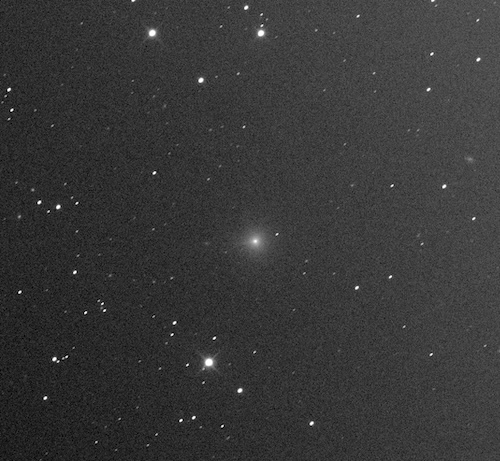 Las Cumbres Observatory images I have taken of Comet MAPS. LEFT: January 14, 2026 (slightly less than two days after the comet's discovery), via the LCO facility at the South African Astronomical Observatory. This is a "stack" of three 3-minute exposures. RIGHT: March 10, 2026 (a little over four days after my first visual observation), via the LCO facility at Siding Spring Observatory in New South Wales. This is a single 3-minute exposure.
At the time of that observation Comet MAPS was located in far eastern Cetus and traveling towards the northwest at approximately 45 arcminutes per day. Over the next few weeks it gradually accelerates and curves more directly westward, and in about two weeks or so it begins disappearing into evening twilight. Recent reports I've read and images I've seen -- including a set I took on the 10th -- suggest it has continued to brighten, and I am cautiously optimistic of observing it another one or two times before it slips into the dusk.
As for what happens when and after Comet MAPS passes through perihelion on April 4 . . . We've essentially been in uncharted territory since its discovery, since no Kreutz sungrazer has ever been discovered this far in advance of perihelion. (Indeed, pre-discovery images of the comet taken as far back as December 18, 2025 by the ATLAS program's telescope in South Africa have since been identified.) At this writing it is already quite a bit brighter than Comet Lovejoy was at a similar point (and much brighter than Comet ATLAS was at its similar point), although it is also about four magnitudes fainter than the great Comet Ikeya-Seki 1965f was at its similar point. (That comet was easily visible with the naked eye during daytime, near magnitude -10, when it passed through perihelion.)
Taking all this at face value, it appears at least somewhat probable that Comet MAPS will survive its perihelion passage, although it may well fragment into several pieces as several previous sungrazers have been known to have done. A couple of hours before perihelion it passes directly behind the sun as seen from Earth, and then a couple of hours after perihelion it passes directly in front of the sun. After that it recedes from the sun, although it remains within a few degrees of the sun for several hours. We should certainly see a good show in the LASCO coronagraphs, and if it is bright enough -- which is at least conceivable, especially since there should be some brightness enhancement due to forward scattering of sunlight, provided there is a significant dust content -- it could theoretically be detectable during daylight. (This will occur during the late afternoon of the 4th from here in New Mexico, when the comet will be three degrees from the sun.)
In the days after April 4 Comet MAPS returns to the evening sky, quite possibly rather bright and with a significantly long and bright dust tail (like previous sungrazers have exhibited). The overall sungrazer trajectory favors the southern hemisphere, but those of us north of the Equator should still be able to see it, although it will remain fairly low in the southwestern sky. It will likely fade quite rapidly, and since it recedes towards the far side of the sun away from Earth, the elongation remains rather small, reaching a maximum of slightly over 36 degrees just after the beginning of May. By that time it will be all but inaccessible from the northern hemisphere, and will likely have faded so much that there may not be much of anything left to see.
Most Kreutz sungrazers have computed orbital periods in the range of a few centuries, but Comet MAPS appears to have a somewhat longer period, in the range of 1700 to 1800 years. In a recent analysis comet scientist Zdenek Sekanina suggests that it may be a fragment of one of several bright comets that appeared in A.D. 363, and thus may be a second-generation fragment of the original sungrazer parent comet, which is widely suspected as being a brilliant comet observed by the Greek scientist Aristotle in 371 B.C.
In any event, it appears at least theoretically possible that we may be seeing a rather bright comet, conceivably even a "Great Comet," in about four weeks' time, although it is also quite possible that Comet MAPS might disintegrate and we won't see much of anything. Considering the current rather dark state of world affairs, it might be good for there to be a bright comet for the people of the world to see, and perhaps begin to grasp our place in the universe and our common humanity. One can always hope . . .
INITIAL OBSERVATION: 2026 March 6.09 UT, m1 = 11.9, 1.2' coma, DC = 1-2 (41 cm reflector, 70x)
UPDATE (March 31, 2026): I was able to grab one more observation of Comet MAPS, on the evening of March 16 -- by which time it was already starting to get fairly low in my western sky after dusk. In my old 8-inch (20 cm) reflector it appeared as a vague and diffuse, slightly condensed glow near 10th magnitude.
According to reports from observers in the southern hemisphere, the comet appeared to stagnate after that, remaining near 10th magnitude for another week before rising abruptly to 9th magnitude. It apparently stayed near that brightness for a few more days before rising, again rather abuptly, to about 8th magnitude. The most recent ground-based observation I'm aware of, made on March 30 from Australia when the comet was at an elongation of 16 1/2 degrees, placed it near magnitude 7.5. Analysis of images taken by satellites in the PUNCH constellation suggest the brightness may have by now increased to perhaps 7th magnitude.
In all honesty, the outlook at this writing for a bright cometary display does not look promising. Daytime visibility when Comet MAPS passes through perihelion on April 4 now looks very unlikely, and a reasonable best-case scenario suggests that we might see something like Comet Lovejoy C/2011 W3 (no. 500) in the days after perihelion, although even that would seem to be rather questionable. All we can really do now is wait and see what the comet does . . . and in the meantime, we should get a better idea once the comet enters the LASCO C3 field-of-view on April 2.
MOST RECENT OBSERVATION: 2026 March 17.10 UT, m1 = 9.9, 3' coma, DC = 2-3 (20 cm reflector, 47x)
UPDATE (April 6, 2026): Comet MAPS did not survive its perihelion passage. While it did appear quite bright in the LASCO C3, and then C2, coronagraphs, by the time it began approaching the central occulting disk in C2 it was starting to fade and exhibit some initial signs of disintegration. It did not re-emerge after perihelion, although, curiously, what is evidently dust in its outer dust tail did later emerge on the opposite side of the sun. Since that time this material has begun to spread out and disperse, and it will likely dissipate completely within the not-too-distant future.
This type of phenomenon is not unprecedented. The very first space-discovered Kreutz sungrazer, Comet SOLWIND 1 1979 XI (new style C/1979 Q1), exhibited an extensive fan of what was apparently cometary dust after its disintegration.
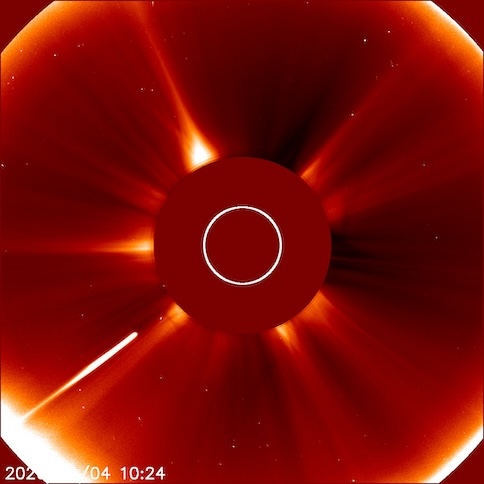
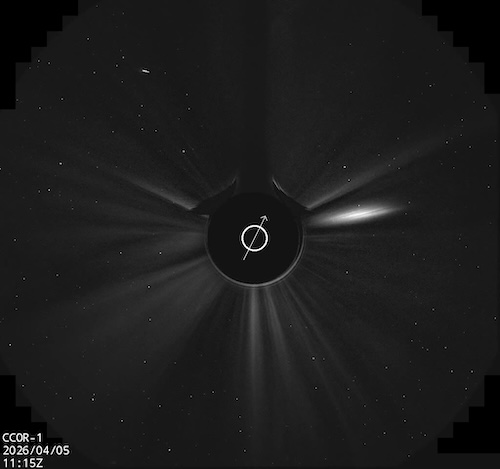 LEFT: Comet MAPS in the LASCO C2 coronagraph aboard SOHO at 10:24 UT on April 4, 2026 (approximately four hours before perihelion passage). Courtesy NASA/ESA. RIGHT: The remnant dust tail, visible as a bright extended cloud, in an image taken by the CCOR-1 coronagraph aboard the GOES-19 weather satellite at 11:15 UT on April 5, 2026 (approximately 21 hours after perihelion). The tail appears to be divided into at least two "synchronic bands." Courtesy NASA/NOAA.
774. COMET PANSTARRS C/2025 R3 Perihelion: 2026 April 19.90, q = 0.499 AU
As I write these words in the fourth week of March 2026, the illegal and immoral war that this nation's leadership started with Iran at the end of February continues on. Thus far I have been unable to establish contact with my friends in that country, although I understand that the Internet there has been essentially cut off. The war has also now spread to Lebanon, but at least I have been able to communicate with my good friend in that country; he writes that "I guess that we are used to wars in this part of the world . . ." What a sad and pathetic commentary on the state of affairs on our planet these days . . .
Meanwhile, those of us in the comet world are closely following the incoming Kreutz sungrazer Comet MAPS C/2026 A1 (no. 773), which had brightened to 10th magnitude when I last observed it a week ago. While reports from observers in the southern hemisphere suggested that it seemed to stagnate after that, there have been some very recent reports of a small outburst to about 9th magnitude. What will eventually happen, and what kind of show (if any) we will see, when it passes through perihelion in a little less than two weeks' time remains to be seen . . .
Regardless of what kind of display we get from Comet MAPS, another comet also shows some promise of being a decent sight next month, although this one will be in the morning sky. It was discovered back on September 8, 2025 by the Pan-STARRS program in Hawaii, at which time it was a rather dim object of 19th magnitude. I began taking images of it via the Las Cumbres Observatory (LCO) network a few days later, and two sets of my observations were included on the comet's discovery announcement. I continued to image it on a semi-regular basis after that, and up through the end of 2025 it remained a dim and barely non-stellar object. However, in early January 2026 I noticed that it had brightened and developed dramatically over the course of the preceding month, which was confirmed by various colleagues of mine once I had reported that fact. I was able to obtain images on a couple of additional occasions up through about mid-month, after which the comet became too low to access with the LCO telescopes, however other observers were able to follow it until early February, by which time it had brightened to about 13th magnitude.
Comet PANSTARRS went through conjunction with the sun -- 27 degrees north of it -- in late February, and shortly thereafter some observers began picking it up, very low in the morning sky, near 10th or 11th magnitude. The elongation slowly increased after that, and various images I saw suggested that it was brightening reasonably fast, so on the morning of March 20 -- by which time the elongation was slightly over 28 degrees -- I decided to make a visual attempt. Despite the comet's low elevation above the eastern horizon I was able to detect it clearly in 10x50 binoculars, and relatively easily in the 10-cm SCT, as a moderately condensed object near 8th magnitude.

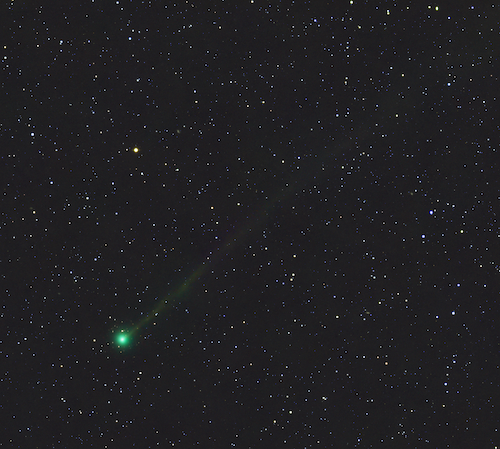 LEFT: Image I took of Comet PANSTARRS on January 9, 2026 via the Las Cumbres Observatory facility at McDonald Observatory in Texas. RIGHT: Comet PANSTARRS on March 20, 2026 -- at almost the exact same time as my visual observation -- as imaged by Chris Schur in Arizona. With the comet's low elevation, and the small instrumentation I was using, I could not see any sign of the ion tail. Image courtesy Chris Schur.
Comet PANSTARRS is traveling in a moderately-inclined retrograde orbit (inclination 125 degrees). It is currently located in central Pegasus half a degree west of the star 40 Pegasi and is traveling somewhat northward of due east at just a little over 10 arcminutes per day, although it accelerates and turns more directly eastward over the next couple of weeks. It reaches a maximum elongation of slightly over 34 degrees on April 7, at which time it will be at a peak northerly declination (just south of +20 degrees) and located one degree southwest of the famous sun-like star 51 Pegasi, traveling at 40 arcminutes per day. Between April 9 and 18 the comet traverses west-to-east across the southern portion of the "Great Square" of Pegasus, at the end of which time its elongation will have decreased to 25 degrees. It will disappear into the dawn sky within another three days or so.
Between April 23 and 26 Comet PANSTARRS traverses the field-of-view of the LASCO C3 coronagraph aboard SOHO as it passes through inferior conjunction with the sun; it is nearest Earth (0.49 AU) on the 26th. By the beginning of May it emerges into the southern hemisphere's evening sky, initially being located in northern Eridanus and traveling rapidly towards the east-southeast; it crosses into southern Orion on May 7 -- passing two degrees north of the bright star Rigel the following day -- then into Monoceros at mid-month (when it will be near a maximum elongation of 46 degrees) and finally into northeastern Canis Major in mid-June.
Comet PANSTARRS appears not to be a first-time visitor from the Oort Cloud -- the most recent return having taken place approximately 140,000 years ago -- and thus there is some reason for optimism that it might achieve naked-eye visibility, perhaps 4th to 5th magnitude, during mid-April before it disappears into the dawn. It may be similarly bright when it becomes visible from the southern hemisphere in early May. Thus far it has not exhibited much in the way of any significant dust content, so whether or not we will see any kind of a dust tail before it sinks into the dawn remains to be seen. If it does develop such a tail, it may exhibit a strong brightness enhancement via forward scattering of sunlight as it transits the C3 field, with a maximum phase angle of 173 degrees taking place on April 25. Afterwards, if it maintains its brightness it might briefly be detectable from the northern hemisphere in early May, although it will be very low in the western sky during dusk.
Comet PANSTARRS accordingly possesses the possibility of putting on some kind of decent show for us, although that show will likely be fairly brief. As a result of planetary perturbations it is encountering during its current passage through the inner solar system it is being kicked into a slightly hyperbolic orbit and thus will eventually be ejected from the solar system. While I really don't believe in this type of thing, perhaps there can be a comforting thought that maybe, just possibly, it might carry off some of our world's current turmoil with it as it leaves us . . .
INITIAL OBSERVATION: 2026 March 20.49 UT, m1 = 8.1, 4.5' coma, DC = 4-5 (10x50 binoculars)
UPDATE (April 17, 2026): Following my initial observations of Comet PANSTARRS in late March, it brightened steadily during the subsequent weeks, and according to various images I've seen it developed a rather striking and structured ion tail, although at least until now it hasn't exhibited any kind of significant dust tail. After waiting out the moonlight and then a couple of mornings of cloudy weather I was able to observe the comet again on the morning of April 16; it was an easy object in 10x50 binoculars, near 5th magnitude with a tail roughly 2 1/2 degrees long. I was able to glimpse the comet with my naked eye shortly after it rose above the trees in that direction, although once dawn got underway I was no longer able to do so. I took the below photograph during early twilight, and it somewhat represents the view through the 10x50 binoculars; the tail extends to the edge of the frame, roughly 6 1/2 degrees.
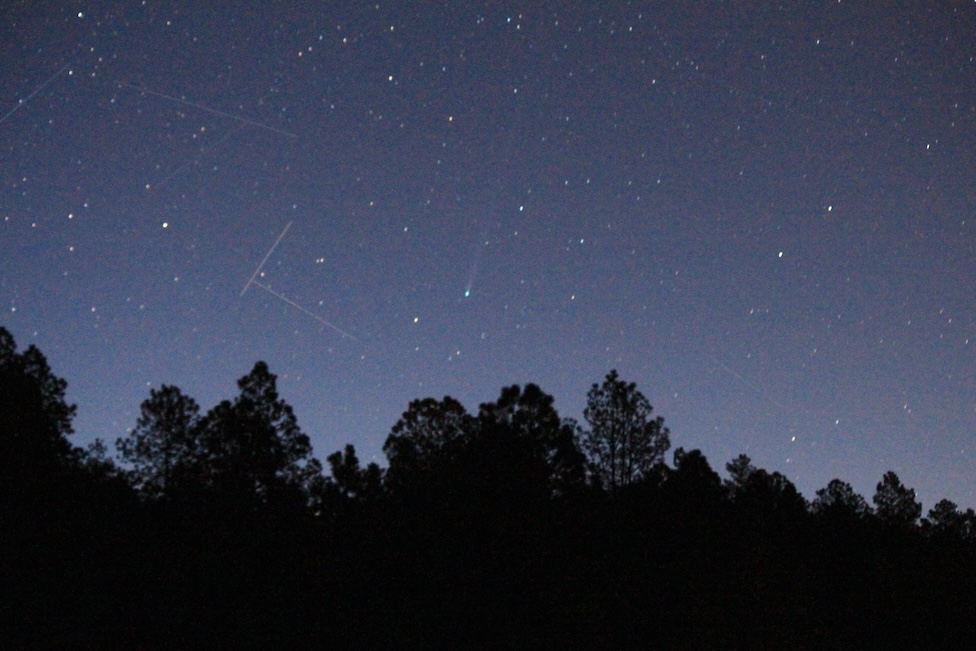
Comet PANSTARRS' elongation was already below 28 degrees at the time of my observation, and it is now traveling rapidly towards the eastern horizon as it approaches its perihelion passage, currently just two days away. It will accordingly be lost in twilight within the very near future, and I do not expect to attempt any more observations before then. The comet begins transiting the LASCO C3 field of view in about six days, but unless it begins exhibiting a dust tail between now and then there may not be much brightness enhancement due to forward scattering of sunlight, and thus it is difficult to predict just how bright and impressive it might appear. Likewise for when it emerges into the evening sky near the end of April; unless it does begin to exhibit a significant dust tail, and/or brightens dramatically, I doubt if I'll be able to obtain any observations then.
MOST RECENT OBSERVATION: 2026 April 16.47 UT, m1 = 5.0, 5' coma, DC = 6-7, 2.5 degree tail in p.a. 290 (10x50 binoculars)
<-- Previous
Next -->
BACK to Alan's Comet Page